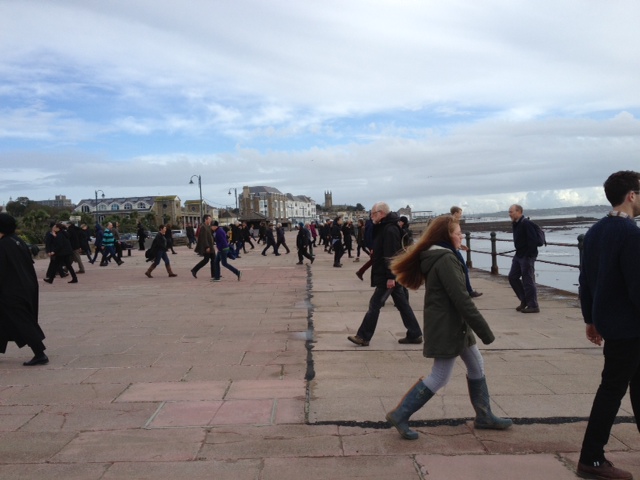
Participants in the Cornwall Workshop arrived in Kestle Barton, the arts centre near Helford which is hosting the workshop, on Friday evening, and attended a keynote talk by Hamish Fulton at Falmouth College. On Saturday, we took part in one of Fulton’s walks on the Western Promenade in Penzance. The promenade is paved with large slabs of sandstone, arranged in lines perpendicular to the coastline. 104 people took part in the walk, which consisted of each participant walking up and down one line of paving slabs. Walking to the sea, and away from the sea, to the sea, and away. Fulton was keen that we shouldn’t stop when we reached the end of our strip, but that we incorporate the turn as part of our walk and not break our pace. We were lined up in such a way that adjacent lines set off from opposite ends of the pavement, so that we began by walking towards each other, but very soon individual rhythms took over and the neatness of the group’s synchronised movement gave way to syncopation. We started at 11 o’clock sharp, by our own time devices, and stopped at noon. The walk took place in silence and Fulton requested that anyone starting the walk should finish it.
There was some discussion before the walk about how we might deal with the repetitive nature of the action, how quickly or slowly time might pass, and – of course – the threat of rain. In the event, it did not rain on this walk; in fact, it got warm enough for people to remove their coats and hastily dump them on the ground at one end of their strip.
This walk is now one of Fulton’s works, logged in the list of private and public walks he has made all over the world. It may or may not result in a photograph, text piece, or mural, which are the formats Fulton uses to produce material works, through which people who weren’t present at the walk can encounter them.
The 104 involved may have experienced what Hamish called on Friday night ‘the freedom of the pavement’. I found myself walking in two voices like a call and response, counting my paces:
‘One, two, three, four’
‘Five, six, seven, eight’
The first ten minutes seemed the longest. Then the intervals at which I checked my watch lengthened until I missed the 12 o’clock finish by a few seconds. I became acutely aware of my senses during the walk, and at one moment in particular, it was as though I was suddenly seeing in colour. I noticed that I was wearing a purple sweater, that the woman walking towards me on the left was clothed in purple from head to toe and had bunched her purple raincoat on the wall at the end of the pavement. I saw a huskie wearing a muzzle being walked by a curious man, I saw a man digging holes on the beach, backlit by sublime sunlight, and I tasted my toothpaste again and again.
I walked to the sea and back towards The Tides restaurant. A woman appeared in the attic window, picked up her smart phone and took pictures of the group. The light on the façade of the building reminded me of an Edward Hopper painting.
Later, when participants in the walk shared their experiences, it was striking how many people commented on the strong social nature of the walk. It was fascinating to look down the line of walkers and notice the variety of movement, facial expressions, clothing and walking speeds. Fulton had encouraged people to start at their own pace, and to walk the hour without speeding up or slowing down. One woman completed just one crossing of the 15-metre wide pavement. She had timed herself so perfectly that she arrived at the sea at 12 noon. She moved in slow motion with extreme muscle control and apparent mental steadiness. Some seemed to be racing to nowhere, while others ambled the short distance before turning back without any visible sense of urgency. People walking at different speeds occasionally lined up and then fell out of synch, a phenomenon that brought to mind Steve Reich’s early phasing works from the 1960s, in which recorded elements or live players start out synchronised and then change tempo, playing until their cycles return to the same beginning and start again.
The walk felt pleasingly social, even though we didn’t talk. The wonder of doing things together in silence comes, in part, from the fact that we so seldom do anything as a group without some kind of vocal event. But on this walk, something happened that posed a threat to the value of our togetherness. In the long stretch of 104 people, I was third in from one end, so I was able to observe the responses of passers-by who walked up to the group, and either wended their way through the bodies pinging back and forth, or avoided the group by walking around it. In most cases, people were guided by their intuition, and avoided colliding with walkers or forcing them to stop on their paths. It was intriguing and touching to watch an old man wearing bright white trainers push a pram through the group, or three teenage girls on bicycles slipping through the group, giggling. Two women walked up to the group and one of them demanded to know what we were doing. She accosted and questioned the first walker in the line her, but got nothing. She then walked round the back of the woman in purple, aping her gait and hollering at her face ‘But what are you doing???’ Her demand was met with silence all round, and she walked off muttering, ‘I know what they’re doing: it’s an installation.’
This incident made me wonder about the exclusivity of the situation and whether the walk was by default alienating to those not taking part. Should there have been posters explaining the walk? More stewards handling questions? Were we occupying a public space that belongs by rights to the locals or were we too legitimate users of the public space? How was the walk being perceived by those watching: as an elegant coming together of people pursuing the same goal, or as a privileged group of people in the know taking over the people’s space?
 Ellen Mara De Wachter